

Lead | Ryan Mason, CFO, Trackforce |
|---|---|
Solutions | Snowball Automation + Cohort Analysis |
Engagement | Phase 1 of an ongoing engagement |
Chassi uses ensemble machine learning to build client-specific, auditable models directly from systems of record.
Intro
Trackforce is an enterprise B2B SaaS revenue business (~$70–80M ARR) that has grown through multiple acquisitions over time (Trackforce, Valiant, TrackTik).* Like many sponsor-backed operators integrating systems and teams post-acquisition, leadership still has to answer the same board questions: Where is growth coming from? Where is it stalling? And what’s driving retention risk—by cohort, not just in aggregate?
That’s the context in which Ryan Mason, CFO at Trackforce, brought Chassi in: not to replace systems, but to make board and budget reporting faster to produce and easier to validate across systems.
*Company background provided by Trackforce
What broke
Trackforce runs a monthly reporting cadence with quarterly board meetings. But as board questions moved beyond topline performance into bottoms-up cohort detail—churn and ARR by segment, vertical, and customer type—answers became harder to produce quickly and harder to defend once produced.
The bottleneck wasn’t analysis. It was assembly and validation. Getting to those cuts required coordinating across teams and systems, pulling tables, and stitching together a view in Excel—often under the pressure of a board timeline. When questions came up in meetings, the team couldn’t always pull the answer on the spot. And when they did come back with a number, the bigger challenge was whether it could be reconciled across functions.
Ryan described it as an “all-hands” effort spanning Finance, Accounting, and RevOps—sometimes starting with a basic uncertainty: can we even get the answer right now?
“It was an all-hands-on-deck approach between Finance, Accounting… RevOps… and a lot of times it was okay, who can even get to this answer?”
Even when the team produced an output, Ryan lacked a consistent way to validate it across functions.
“I couldn’t validate what I was getting from RevOps with Finance or what I was getting from Finance with Accounting… you kind of just had to take whatever we got back as as the gospel. And that’s not a comforting feeling, right?”
The pressure point underneath all of this was the snowball. It was built manually, took days, and changed from one version to the next—creating the kind of fragility that becomes dangerous during budget season, when topline assumptions drive everything downstream.
“Several days to put together… ripe with the opportunity for error.”
What changed
Trackforce evaluated vendors to automate reporting, but many options implied an ERP-scale replacement—moving transactions, reporting, and workflow into a new platform. Trackforce didn’t need a new system. They needed a faster, defensible way to answer board questions and streamline monthly reporting using the systems they already had.
Under the hood, Chassi uses ensemble machine learning to build a client-specific model from systems of record (not third-party generative AI or shared large language models). Outputs are traceable back to source data, which helps teams move faster without treating the analysis as a black box.
Ryan explained why Chassi stood out in that search:
“Chassi really stood out because it didn't require us to completely change how we operate…”
From there, the timeline mattered. Contrasting long implementation windows with getting a working base case running in months was key—fast enough to be useful inside real planning and board cycles.
“Some of these guys were talking… eight months to a year. With Chassi, we had a base case up and running in a couple of months!"
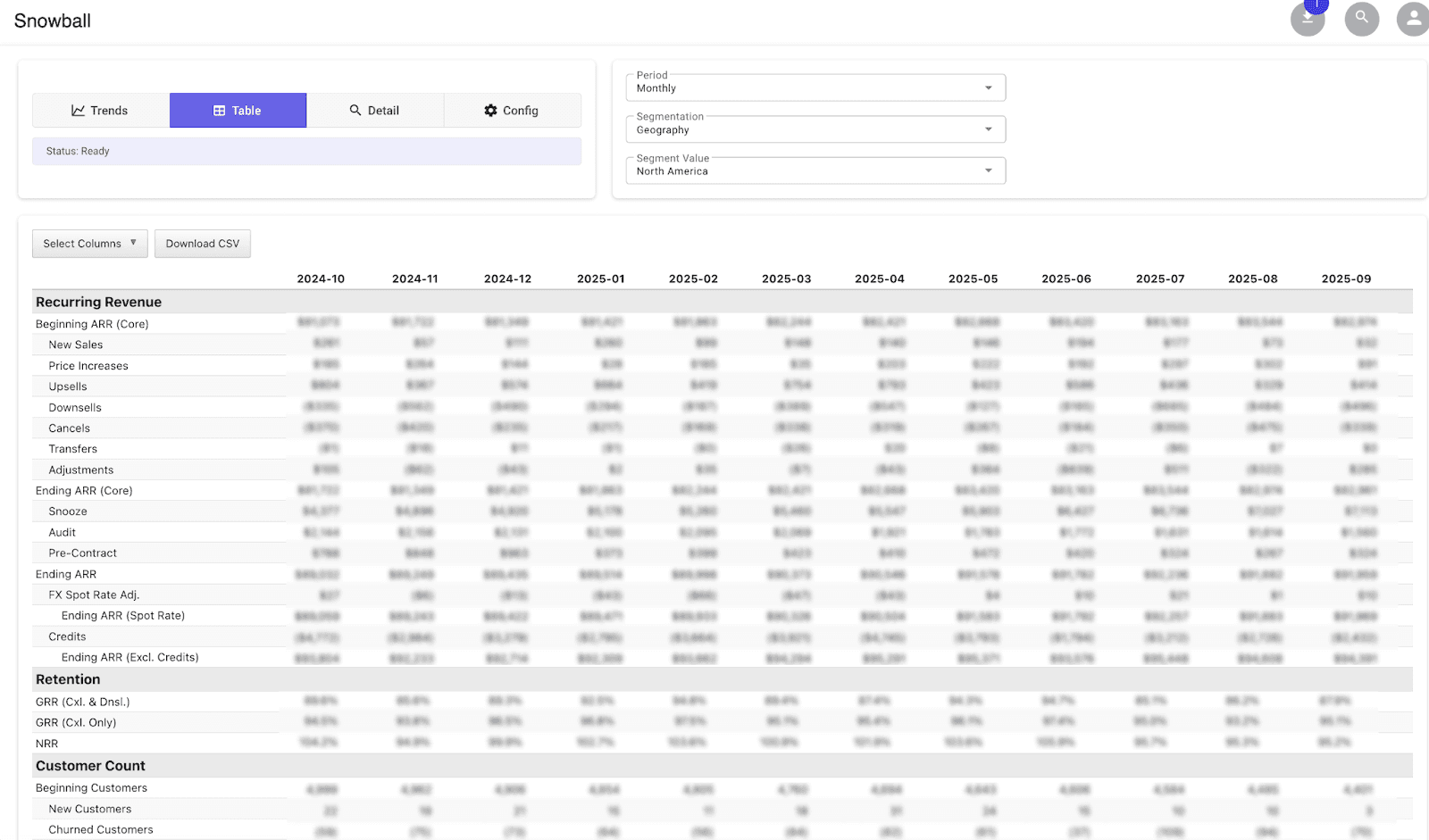
Overview of Chassi ARR Snowball (anonymized and illustrative)
With that base case in place, the reporting conversation could change. Instead of assembling cohort cuts through manual pulls and reconciliations, Trackforce could shift toward repeatable cohort-level views that were easier to review internally, answer questions against, and use as an operating input—especially when the next board question wasn’t whether a metric moved, but where and why.
The GRR investment case
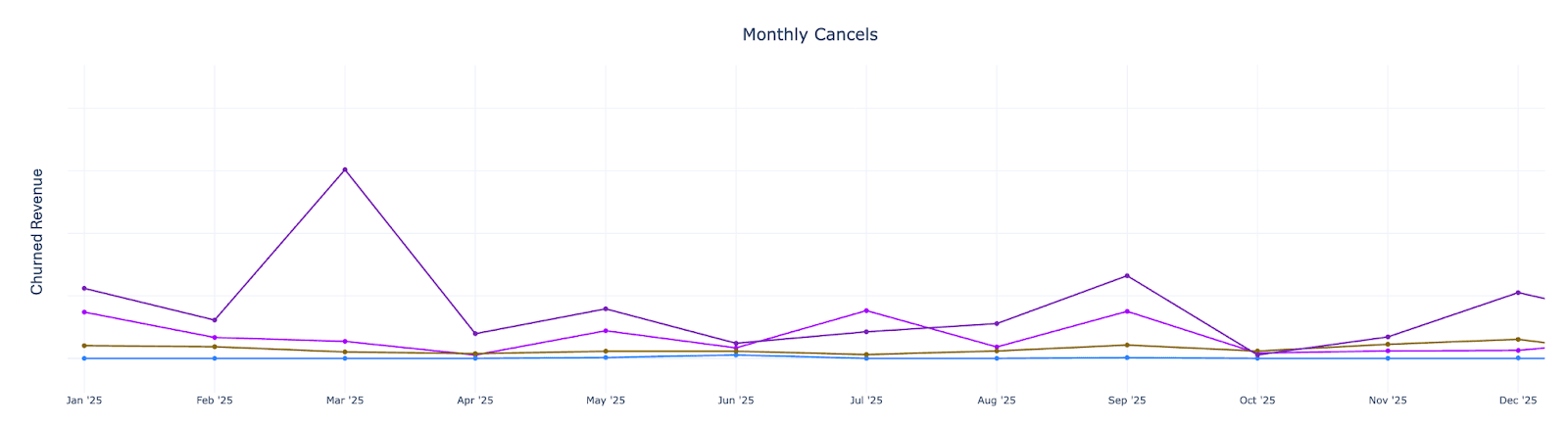
Once churn was visible across pockets of the customer base, Trackforce made a targeted product investment designed to improve retention—internally named the GRR investment case.
“Late, last year, we made an investment and we called it the GRR investment case.”
Ryan described using churn insight to see where risk was concentrated, then tying it back to product work and customer tickets so the investment addressed specific issues showing up in the data—not just a generalized desire to “improve retention.”
“The platform relative to [churn] was really insightful as to where we were seeing [churn] across the various pocket[s]… and we could then take that information and apply that against the tickets… and make investments… to go improve product…”
The signal & what's next
Ryan shared how GRR was trending at the time—an early directional signal as Trackforce continued executing on its retention focus.
This story is still in motion. Trackforce plans to use Chassi throughout 2026 to spend less time assembling reporting and more time analyzing trends and making investment decisions as the year unfolds.
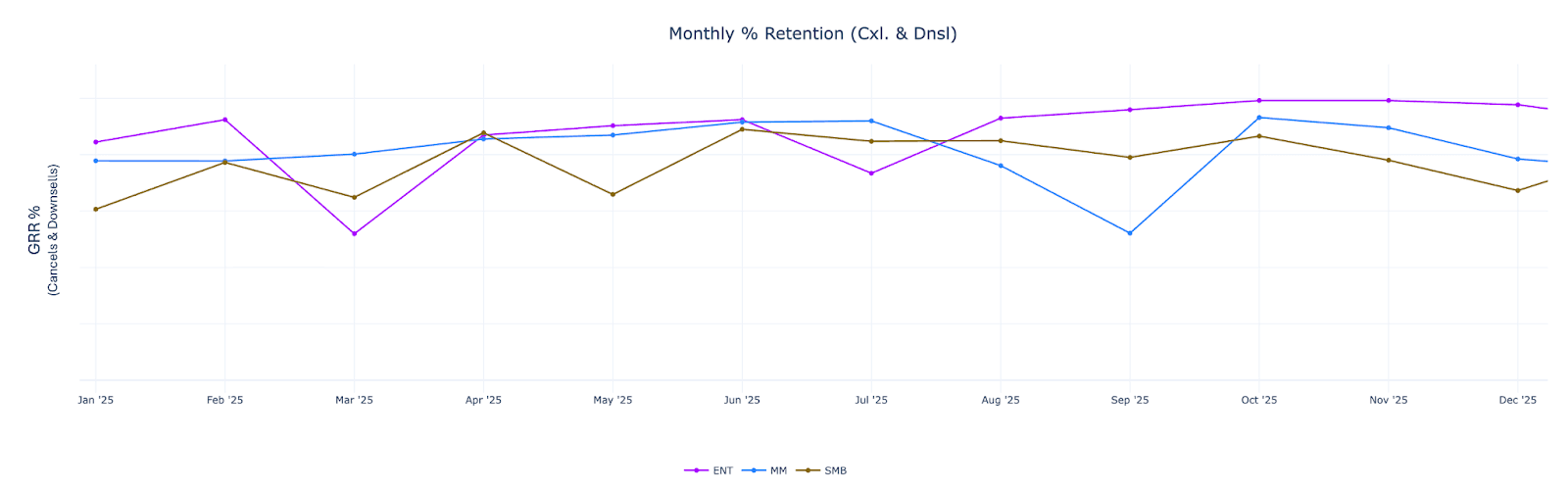
Gross Revenue Retention rate (GRR) by customer segment
Phase 2 will cover what changes when time savings and cohort visibility become part of the operating cadence—how Trackforce uses Chassi to guide adjustments, investments, and ongoing performance management.
As the engagement continues, Trackforce expects to extend from descriptive reporting into more forward-looking analysis—using the data foundation and operating blueprint built during Phase 1 to better understand decision drivers, risk, and opportunity at a more granular level.
Behind the speed in Phase 1 is a deliberate technical approach to trust. Chassi uses ensemble machine learning to generate client-specific models (never trained on other clients’ data) and ingests only the fields needed for the analysis. Insights are interpretable and traceable by design, so finance teams can map outputs back to source records instead of relying on an opaque black box.


Empower your growth strategy with Chassi
Clarity in days with read-only connections and minimal lift.