

Cash sits in the gaps between billing and collection
Invoicing lags, inconsistent terms and slow approvals push collections out. AR aging builds by customer and entity without a clear cause. The cash forecast is built from averages, and the quarter-end position arrives as a surprise.
What that looks like in practice:
Invoicing lags that inflate DSO
Payment terms that drift from policy by customer or entity
AR aging that builds without a traced cause
Cash forecasts built on averages, with no link to contract terms
Net working capital questions in diligence the team can't answer quickly
Chassi shows where cash is sitting, when it will arrive, and which fixes move it fastest. No manual data prep. No system changes.

How it works
Three steps from Order-to-Cash, with every delay traced and ranked.
Connect systems of record
Read-only connections to ERPs, CRMs, and billing systems. No system changes.
Trace Oder-to-Cash
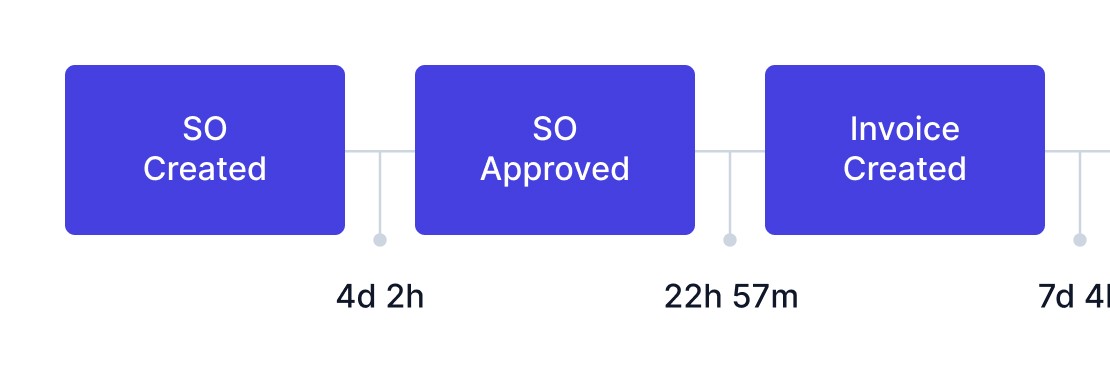
Every transaction is traced from order through invoice through payment. Billing lags, approval delays and payment-timing variances are measured by entity, segment and customer.
Act on a ranked cash plan
Actions ranked by cash impact and complexity, DSO scenarios tied to specific process steps, and a plan with named owners and dollar targets.
First material findings in 3–4 weeks.
What lands on your desk
Net working capital by entity and period, with the drivers behind each movement
Receivables aging, credit exposure and collection risk by customer
A collections forecast built from contract terms and payment history
DSO scenarios tied to specific process steps
A prioritized plan ranked by cash impact and complexity
What your team can do with it
Explain every NWC movement to the board and lenders, and to buyers in diligence
Focus collections and credit terms on the accounts most at risk
Plan hiring and spend around cash you can see before quarter-end
Choose the process fixes that move DSO most
Free up cash by starting with the highest-value fixes
Real-world impact
A PE-backed enterprise data platform used Chassi to trace order-to-cash across seven subsidiaries.
$7.4M in free cash flow identified
~$4.9M trapped in U.S. billing lags
~$2.3M trapped in international billing lags
$210K unlocked by aligning payment timing to Net 30
Credit memo inconsistencies flagged for policy and reporting fixes


Reconciled first. Reported second.
How Chassi gets every number to tie out, and keeps it that way through exit.
Built from raw system outputs
Chassi builds the clean data layer from what your systems actually record.
A team that does the data work
A forward-deployed Chassi team owns the reconciliation. Your team reviews findings.
Kept current through the hold period
The model updates as the business moves, so the numbers are ready when the board, auditors, or a buyer test them.
Read-only, no system changes
Nothing in your stack is replaced or reconfigured.
We're not in a liquidity crunch. Is this still worth doing?
Trapped cash is a drag on free cash flow whether liquidity is tight or not, and net working capital is one of the first things a buyer tests. Finding it before diligence keeps it out of the price negotiation.
We have several subsidiaries on different ERPs. Can Chassi handle that?
Yes. The $7.4M finding came from an engagement across seven subsidiaries. Multi-entity, multi-ERP structures are where process variance accumulates.
We already use Tableau, Power BI or Looker. How is Chassi different?
BI tools chart the cash data they receive. Chassi traces each delay to the process step responsible and ranks the fixes by cash value.
We can't act on every finding at once. How do we prioritize?
The plan is ranked by cash impact and complexity, so the highest-value fixes come first.
Will this disrupt operations?
No. Read-only connections, no system changes.
Do you know where your cash will be at quarter-end?
See where cash is sitting in your order-to-cash process.