

Booked vs. billed: the gap is costing you more than you think
When a contract amendment doesn't reach billing, or an escalator triggers at the wrong rate, every system still reports cleanly. The CRM shows the deal. Billing shows the invoice it was told to send. Nobody flags the difference, and it repeats every billing cycle.
Where revenue leaks:
Billing errors: wrong rates, missed price escalators, unbilled line items
Contract gaps: amendments, renewals, and change orders that never reached billing
Recognition lag: delays between delivery, invoicing, and recognized revenue
Where cash leaks:
Credit memos: issued without reason codes, so the error behind them is never fixed
Short payments and disputes: customers pay less than invoiced because an invoice didn't match the contract
Write-offs: balances cleared as bad debt that trace to a billing or contract error upstream
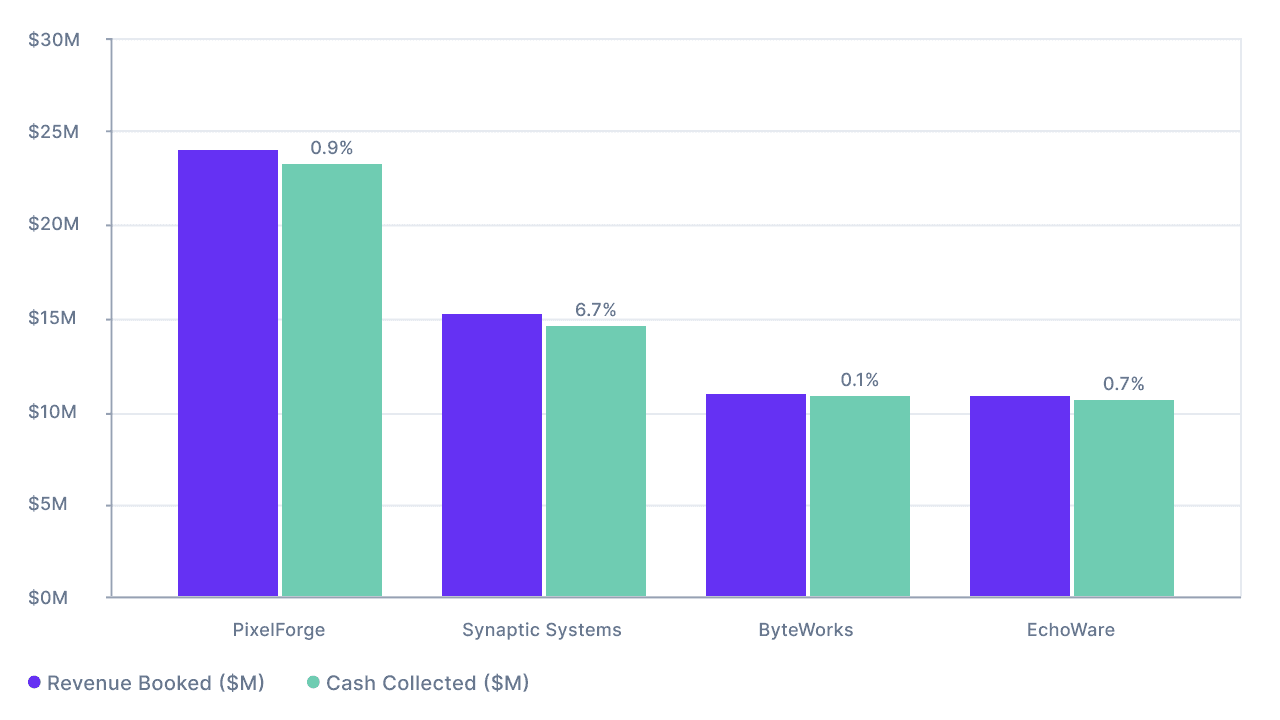
Chassi reconciles booked, billed, and collected at the line-item level, sizes the leakage, and delivers a plan to recover it and prevent it from recurring

How it works
Three steps from signed contract to recovered revenue.
Connect systems of record
Read-only connections to CRMs, ERPs, billing systems, and contract data. No system changes.
Reconcile the full revenue path
Every contract, order, invoice, and payment is matched against contracted value. Discrepancies surface at the line-item level, so leakage is sized from your data.
Recover and prevent
You get a prioritized recovery list with named owners and expected dollar impact, plus the billing policy and approval fixes that stop the same leak from recurring.
First material findings in 3–4 weeks.
What lands on your desk
Leakage sized by customer, product, segment, and entity
Contract-to-cash exception tables at the line-item level
Credit memos, short payments, disputes, and write-offs traced to the error behind them
A prioritized recovery list with owners and expected impact
Billing policy and approval-path fixes to prevent recurrence
What your team can do with it
Start with the largest leaks by dollar value
Fix mismatches before the next billing run
Collect short-paid balances and stop repeat credit memos and write-offs
Track recovered revenue against expected impact, item by item
Keep the same leakage from returning next cycle
Real-world impact
$21M in recoverable revenue identified.
A PE-backed software company used Chassi to reconcile contract-to-cash across business units. Chassi found underbilling, missed uplifts and pricing overrides totaling $21M in recoverable revenue, and delivered a prioritized plan to recover it and prevent recurrence.


Reconciled first. Reported second.
How Chassi gets every number to tie out, and keeps it that way through exit.
Built from raw system outputs
Chassi builds the clean data layer from what your systems actually record.
A team that does the data work
A forward-deployed Chassi team owns the reconciliation. Your team reviews findings.
Kept current through the hold period
The model updates as the business moves, so the numbers are ready when the board, auditors, or a buyer test them.
Read-only, no system changes
Nothing in your stack is replaced or reconfigured.
Our finance team reconciles monthly. Wouldn't they have caught this?
Monthly reconciliation catches large variances. Pattern-level issues are harder to see: systematic underbilling on one product line, missed escalators on multi-year contracts, credit memos that net out in aggregate. Chassi reconciles at the line-item level across CRM, billing and the ERP.
We run NetSuite and Salesforce. Doesn't the integration handle this?
Integrations move data between systems as it was entered. If an amendment never reached billing, both systems agree with each other and both are wrong. Chassi compares what was contracted against what was billed and collected, account by account.
How is cash leakage different from working capital?
Working Capital Intelligence covers when cash arrives. Cash leakage covers cash that never arrives: credit memos, short payments, disputes and write-offs, each traced to the billing or contract error behind it.
What's a realistic finding?
Within the first engagement, Chassi has found 3–6% of contracted revenue underbilled. The amount depends on contract complexity and how long the leakage has been accumulating. The 21Mfindingcamefromamulti-product,multi-entity company.[CONFIRM:drop or restatelegacy"2.2M per $100M ARR"]
Our data is messy. Do we need to clean it up first?
No. Finding where the data breaks is part of what the engagement delivers.
Will this disrupt operations?
No. Read-only connections, no system changes.
How much of what you've contracted is actually being billed?
See what Chassi finds between booked, billed and collected.